




How to Write a Website Brief Before You Ask Agencies for Quotes
What a website brief should include so agencies in Singapore can quote accurately: goals, pages, content, migration, PDPA, budget and what to ask back.

The short answer
- 01
A brief is what makes quotes comparable. Every section you leave out is filled in by each agency's own assumption, and each assumption carries a different price.
- 02
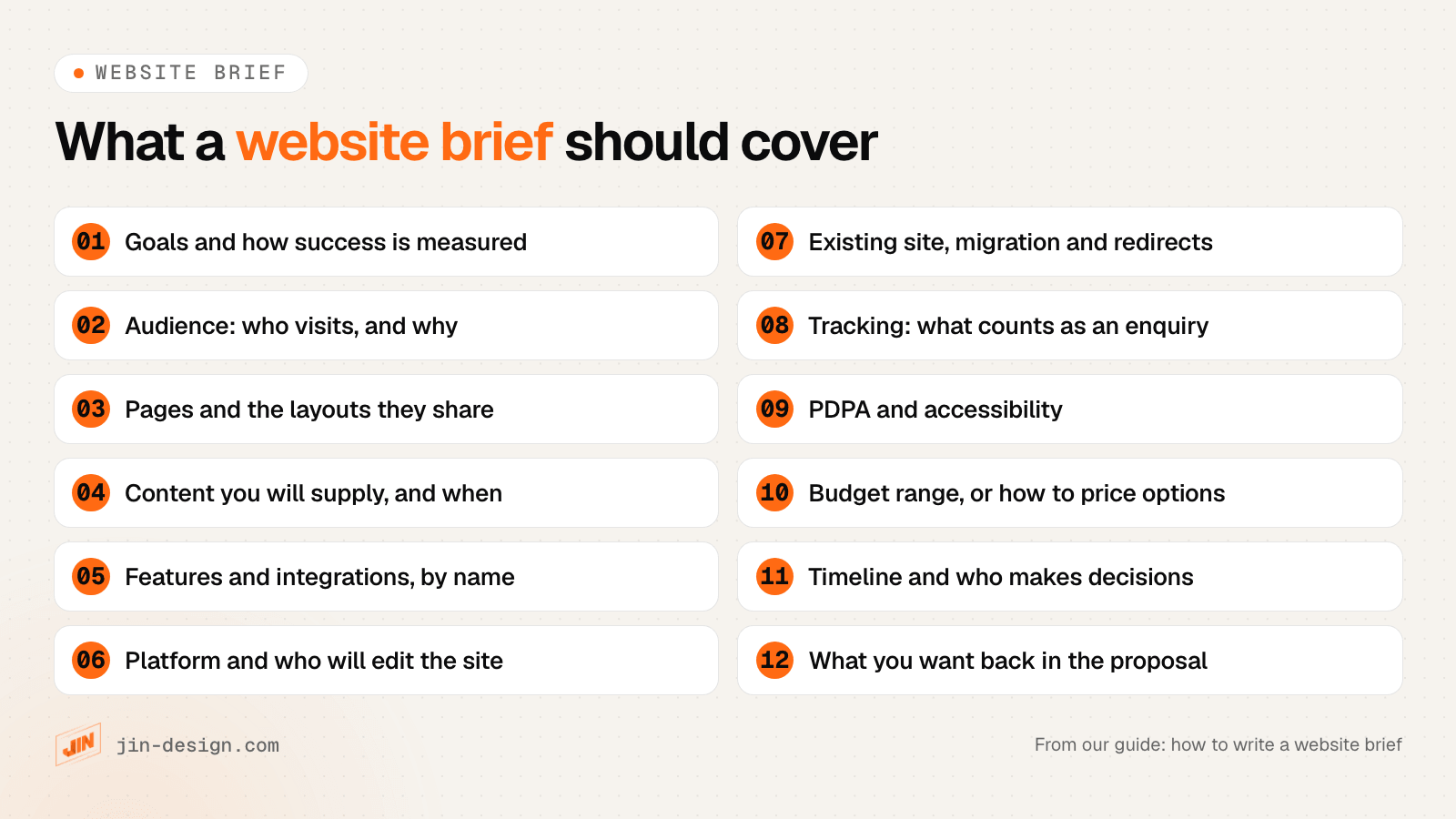
Cover the sections agencies price. Goals and how you measure them, audience, pages and layouts, content you supply, integrations by name, platform and who edits, your old site and redirects, tracking, PDPA and accessibility, budget, timeline and decision makers.
- 03
Say what you want back. Ask every agency to price against the brief's sections, list assumptions and exclusions, and show running costs and GST separately, so you can compare like for like.
A website brief is a short document that tells agencies what your website must achieve and what they would be pricing: your goals and how you will measure them, who the site is for, the pages and layouts, the content you will supply, features and integrations, the platform and who will edit it, what happens to your current site, tracking, PDPA and accessibility needs, a budget range, the timeline and who decides. Send the same brief to every agency and say what you want back, and the quotes you receive can be compared line by line.
As a web design and web development agency in Singapore, we ask for a brief or a call before we quote, so this guide is written from the side of the table that reads them. It covers what each section should say, how to share a brief and compare what comes back, the gaps that lead to change requests later, and a full example for a fictional Singapore business, with a free Word template to fill in.
Why do agencies need a website brief to quote accurately?
An agency prices the work it expects to do. When the brief does not say how many layouts the site needs, who writes the copy or whether an old site has to move, each agency fills the gap with its own assumption. One assumes you supply final copy; another assumes it writes every page. Both quotes can be fair, and they still cannot be compared.
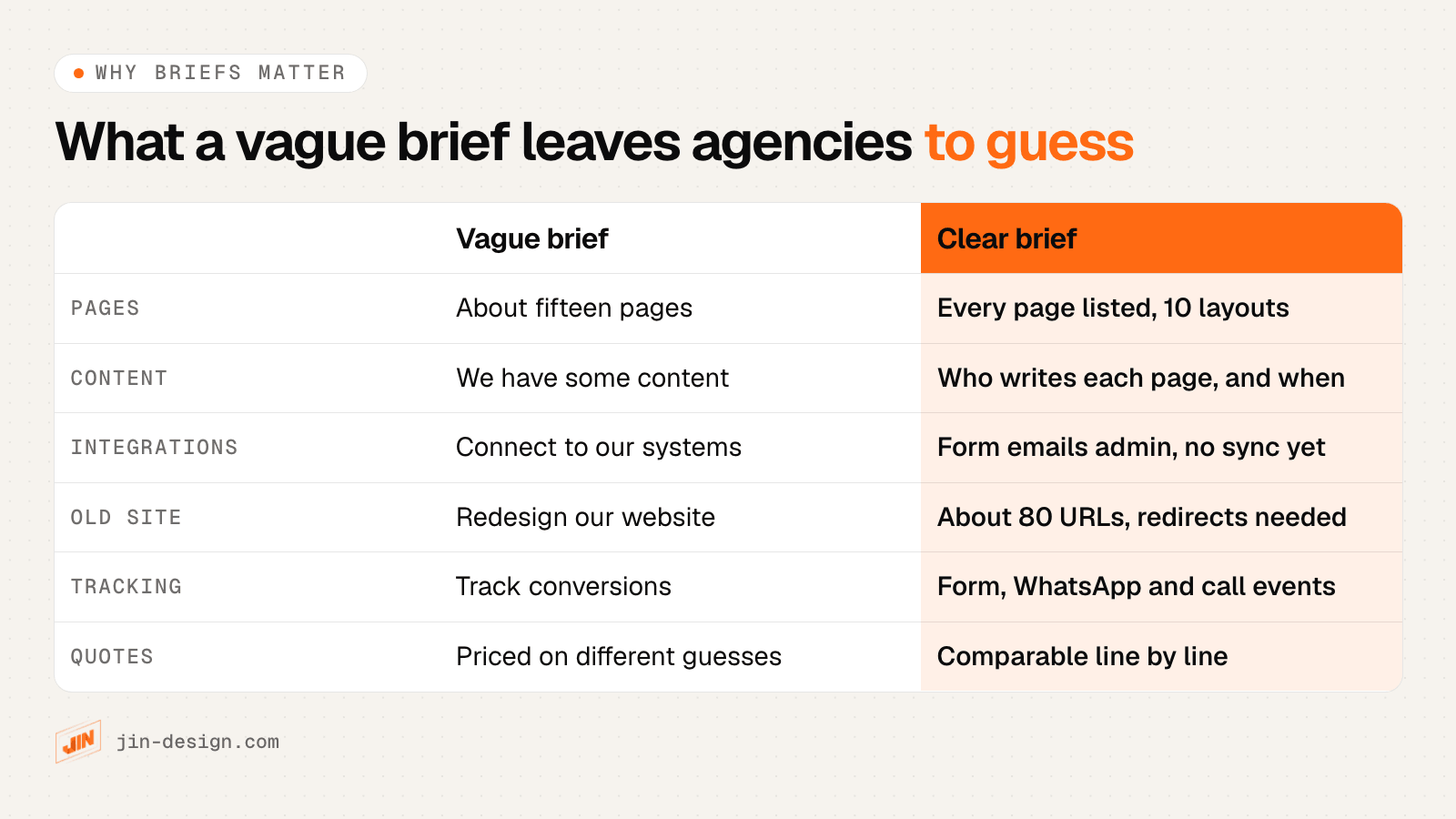
Our guide on how much a website costs in Singapore explains the lines that move a quote most: unique page layouts, content, integrations, ecommerce, languages, migration and care after launch. A brief is where you write each of those down before anyone puts a number on them. If you would rather work in a spreadsheet, the free website scope worksheet covers the page and feature lists and has a tab for comparing quotes.
What should a website brief include?
These are the sections an agency needs to price a website, and the ones the Word template walks you through. A line such as “not sure yet, please advise” is a useful answer; a missing section is not, because nobody can tell whether you forgot it or do not need it.
Goals and how success is measured
Name the main job of the website, such as enquiries, trial bookings, online sales or job applications, and the one action that proves it worked. “A modern look” is a reason to redesign, but it does not tell an agency what the pages must lead visitors to do.
Then say how you will measure it: the number of form enquiries a month, booked calls, or sales through the site. If you track nothing today, say so. That tells the agency the tracking set-up belongs in the quote.
Audience: who visits, and why
Describe the main groups of visitors, what they need to find before they contact you, and what might stop them. Note the devices they use if you know (your analytics will show it) and the languages they read.
A few sentences per group is enough. What you write here shapes the page structure and the copy.
Name a few competitors or similar businesses too, and what you notice about their sites.
Pages and the layouts they share
List the pages you expect, then group them by the layout they share. Forty product pages that share one layout are one design job; a home page, a pricing page and a contact page are three. The number of unique layouts is a better guide to effort than the page count.
Mark each page as must-have or nice-to-have. That lets agencies price a core scope and options separately, which makes the quotes easier to compare.
Add a few sites you like and what you like about each, and list the brand assets you already have, such as a logo, a brand guide, fonts and photos.
Content you will supply, and when
For each page, say who writes the copy, who supplies photos and video, and whether you own the rights to them. Give a date for anything you will supply.
On our own projects, content is usually the step that takes longest, which is why we plan it from day one. A brief that says “client supplies copy for programme pages by week 3” lets an agency plan around it; “we have some content” does not.
Features and integrations, by name
List what the site has to do beyond showing pages: forms, booking, a members area, online payments, search, a blog, a careers page. For each integration, name the product you use and what should happen. “Enquiries go into our CRM as new contacts” can be priced. “Connect to our systems” cannot, because it could mean an email notification or a two-way sync.
If you do not need an integration yet, say that too. “Form emails the admin team; no system sync in phase one” keeps the scope honest.
Platform and who will edit the site
If you have a platform you must use, say why: an existing team skill, an app you depend on, or a company IT policy. If you have no preference, say who will edit the site, how often, and what they will change. A site whose timetable changes every term needs different editing tools from a site that changes twice a year.
Our comparison of WordPress, Webflow and AI-powered websites covers the trade-offs. Ask agencies to recommend a platform and give their reasons, rather than picking one for them.
Existing site, migration and redirects
If you already have a website, this section protects your Google traffic. Give the current address, the platform it runs on, roughly how many pages and posts it has, and the pages that bring in the most visits. Offer read access to Google Search Console and your analytics, so the agency can see which addresses matter.
Google’s guide to moving a site with URL changes asks you to map every old URL to its new one, use server-side permanent redirects, and keep them for at least a year. That mapping is real work. When we moved jin-design.com off WordPress, our redirect list ran to more than 250 old addresses. Our free sitemap checker helps you list your current pages, and the redirect checker tests the redirects after launch.
Also note who holds the domain, hosting and email accounts, and when they renew. A .sg domain is registered through one of the registrars accredited by SGNIC; the account should be in your company’s name.
Tracking: what counts as an enquiry
List the actions that count as a conversion on the new site: a sent form, a tap on a WhatsApp or call button, a booking, a purchase. In Google Analytics 4, important actions are marked as key events. If you run Google Ads, say so, because the conversions need to reach your ads account too.
When tracking is in the brief, it is set up and tested before launch. When it is not, it tends to be added later, after the first months of data are already lost.
PDPA and accessibility
A form that collects personal data from individuals, such as names, emails or phone numbers, falls under the Personal Data Protection Act. The brief should say what each form collects and why, where submissions should go and who in your company can see them. The agency and the host may process that data for you as data intermediaries, and under section 4 of the PDPA your obligations for it stay the same, so ask each agency where submissions are stored. Our guide to the PDPA for websites in Singapore covers form notices, opt-ins and cookies. This is general guidance, not legal advice.
For accessibility, name a target rather than writing “accessible”. The usual reference is WCAG 2.2, the W3C’s accessibility guidelines, at level AA. Our contrast checker helps you check your brand colours against it early.
Budget range, or how you want options priced
A range, or a ceiling, lets an agency propose an approach that fits instead of guessing your appetite. If you would rather not share it, say how you want options priced: the core scope as one figure, then each nice-to-have and each optional language or integration as its own line.
Also say whether you plan to apply for a grant, because that changes how the quote must be written. The grant section below explains why.
Timeline and who makes decisions
Give the launch date and why it matters, such as a campaign, an event or the start of a new enrolment period. Note any dates when your team is unavailable.
Then name the people involved: the day-to-day contact, who supplies content, and who gives final approval. A design approved by the project contact and then reopened by a director who was not involved costs everyone a round of changes, so bring the final decision maker into the first design review.
What should you ask for back in a website proposal?
The last section of the brief tells agencies what to send. Asking every agency for the same things is what turns a pile of proposals into a comparison.
- Pricing against the brief’s sections, with the core scope and each option on separate lines.
- Assumptions and exclusions, in writing: for example how many unique layouts and how many rounds of changes are included, and anything not included, such as photography or content entry.
- The recommended platform, with the reasons it suits your team.
- A plan for your current pages and redirects, if you have an existing site.
- A timeline with milestones, and what the agency needs from you at each one.
- The team: the names and roles of the people doing the work.
- Running costs per year, such as hosting or a platform plan, paid apps and a care plan, and who bills each one.
- GST shown clearly as included or added. GST-registered businesses charge GST at 9%, according to IRAS.
- Ownership: confirmation that the domain, content, design files and accounts are yours.
- Payment stages and what you receive at each one.
Free download
Website brief (Word). Every section in this guide with guidance under each heading, tables for pages, content, integrations, tracking and approvals, and a fully filled example for a fictional Singapore tuition centre.
Can you use a grant for the website in your brief?
Possibly, but only in specific cases, and the rules decide how the quote and payment must be arranged. Enterprise Singapore replaced the Productivity Solutions Grant (PSG) and two other grants with the EDGE Grant on 30 September 2026.
EDGE grant facts for a website brief (checked 15 October 2026)
- The list of pre-approved single-function digital solutions has no category for a company website on its own.
- An E-Commerce Online Shop (B2C) package can get up to 50% support for SMEs, on a cost capped at S$5,000.
- The package on IMDA's SMEs Go Digital should match the vendor quotation exactly, and you must not start work or pay any deposit before you submit the application.
Sources: Enterprise Singapore, E-Commerce Online Shop (B2C) and single-function digital solutions.
For a brief, that means planning to fund a company site without an online shop yourself. If the site includes an online shop and you want to use EDGE, say so in the budget section, so agencies with a pre-approved package can quote that package exactly and price anything beyond it separately. Do not sign or pay a deposit until the application is in. Our guides to website and AI grants in Singapore and how much a website costs cover the full EDGE rules.
How do you send a website brief to agencies?
Send the same document to every agency on your shortlist, with a date for questions and a date for proposals. Our list of web design companies in Singapore is one place to start building that shortlist.
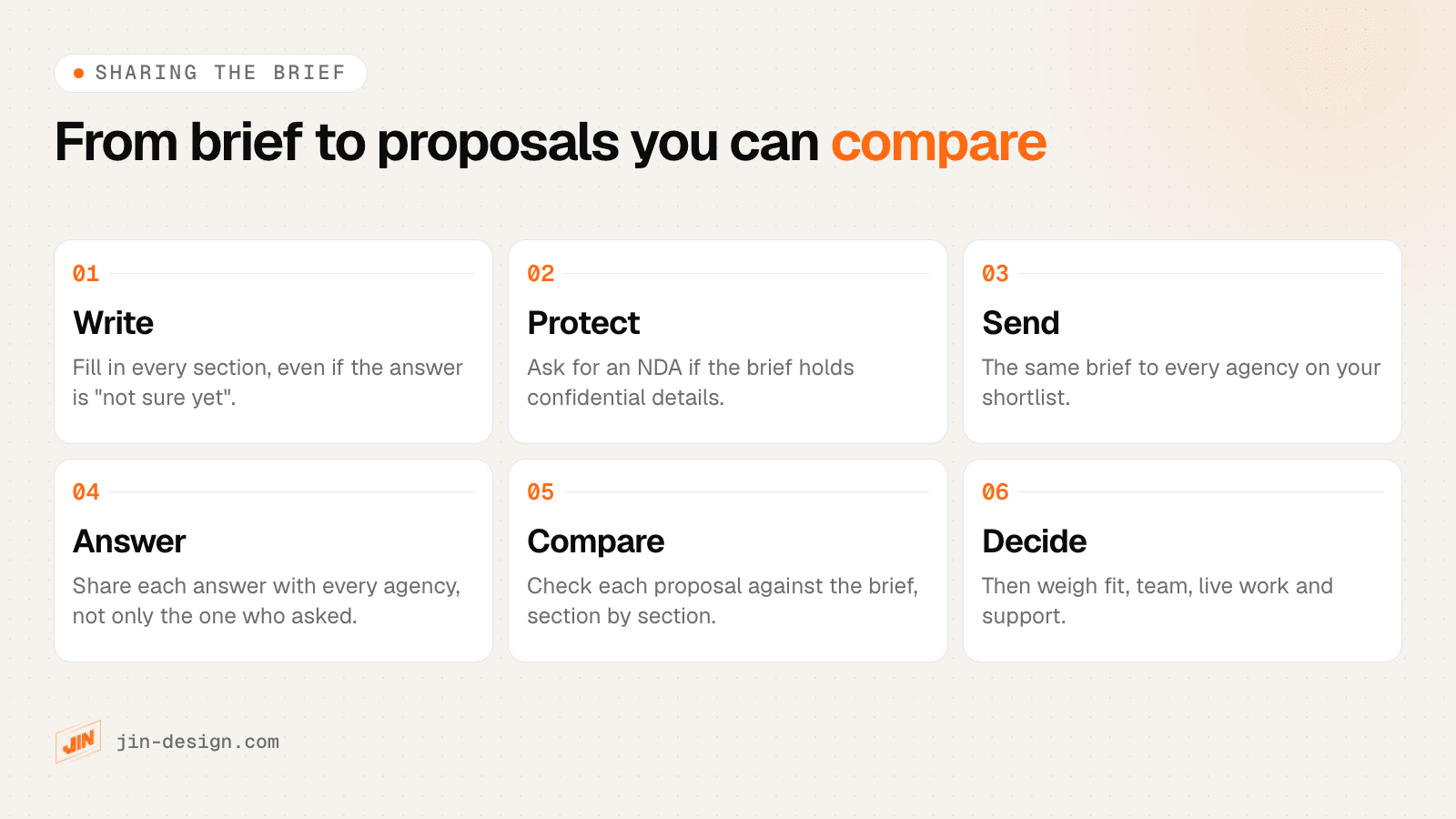
- Use an NDA only where it is needed. If the brief describes unreleased products, internal figures or system details, ask agencies to sign a non-disclosure agreement first, or send a version without those details for the first round. If the brief has none of these, you need neither.
- Keep personal data out of the brief. Describe your customers; never attach customer lists or form exports. Give Search Console and analytics access as read-only users, and remove access for agencies you do not appoint.
- Answer questions for everyone. When one agency asks something that changes the scope, send the answer to all of them, so every proposal prices the same project.
- Offer a call. A short call after agencies have read the brief often brings out the questions a document cannot. Keep notes, and add anything new to the brief.
How do you compare website proposals against your brief?
Put the proposals side by side and go through the brief one section at a time. For each section, note what each agency included, what it assumed and what it left out. A gap is a question to ask, not a reason to rule an agency out: send it as a follow-up and give everyone the same chance to answer.
Once the scope is the same, compare price with three years of running costs added; the Compare quotes tab of the website scope worksheet adds those up for you. Our guide on how to choose a web design agency in Singapore has the questions to ask and a scorecard for proposals.
What gaps in a website brief cause change requests later?
Many change requests trace back to something the brief did not say. Each gap below has a section of the brief that prevents it.
| What happens later | Why it happens | Prevent it in |
|---|---|---|
| New layouts are needed halfway through | Pages were counted, not grouped by layout | Pages and layouts |
| Launch slips while copy is written | Nobody was named to write it, or no date was set | Content |
| An integration takes far longer than planned | “Connect to our CRM” was read as a simple form hand-off | Features and integrations |
| Search traffic drops after launch | Old URLs were not mapped and redirected | Existing site and redirects |
| A second language is added after launch | It was planned “later” and never scoped | Audience, Pages and layouts |
| The team cannot update the site | Who edits, and what, was never discussed | Platform and who edits |
| Nobody can say if the site works | Conversions were not defined before launch | Tracking |
| Forms are reworked before launch | Consent wording and data storage were left to the end | PDPA and accessibility |
| Approved designs are reopened | The final decision maker joined late | Timeline and decision makers |
What does a completed website brief look like?
Here is a condensed brief for Pebblewood Learning, a fictional tuition and enrichment centre with two centres in Singapore. It is invented to show the level of detail that helps an agency quote. The full version, with every table filled in, is Part 2 of the template.
1. Goals and success. More trial class bookings from parents. Success: trial class requests sent through the site each month, counted in GA4. WhatsApp taps are counted separately.
2. Audience. Parents of upper primary and secondary students, mostly on phones in the evening. They want to know the class sizes, the tutors, the timetable and the nearest centre before they book. Many parents read Chinese as well as English. On other tuition centres’ sites, parents look first for class sizes and the timetable.
3. Pages and layouts.
| Page | Layout | Priority |
|---|---|---|
| Home | Home | Must-have |
| About us, FAQ, contact, privacy policy | Standard page | Must-have |
| Programmes overview | Programme listing | Must-have |
| Programme pages (8, one per level and subject group) | Programme page | Must-have |
| Our tutors | Tutor listing | Must-have |
| Centre pages (2) | Centre page | Must-have |
| Timetable | Timetable | Must-have |
| Book a trial class | Form page | Must-have |
| Blog listing and posts (about 40 kept from the old site) | Blog listing, blog post | Must-have |
| Chinese versions of home, programmes overview and trial booking | Same layouts | Option, price separately |
That is 10 unique layouts.
4. Content. Pebblewood writes the programme pages and tutor profiles by week 3; the agency writes the home and about pages and edits the rest. Photos of both centres are Pebblewood’s own; tutor photos are used with each tutor’s consent.
5. Features and integrations. Trial class form (parent name, mobile, email, child’s level, subject, preferred centre and slot) emails the admin team. No sync with the student management system in phase one. WhatsApp button with a pre-filled message. A map on each centre page.
6. Platform and editing. No preference. Two admin staff, not technical, update the timetable each term and publish a blog post most weeks. Please recommend a platform and explain why.
7. Existing site. WordPress, about 80 URLs including the blog. The top landing pages are listed in an appendix, and read access to Search Console and GA4 will be given on request. Keep the blog posts that bring visits, redirect everything that moves. The .sg domain is in the company’s name.
8. Tracking. GA4 and Search Console. Key events: trial class request (on successful submission) and WhatsApp tap. Call taps are tracked as a secondary event, because only the tap can be counted, not the call.
9. PDPA and accessibility. A notice next to the form saying how the details are used, and a separate unticked opt-in for marketing messages. No NRIC numbers. Form data visible only to the admin team. Accessibility target: WCAG 2.2 level AA.
10. Budget. A range is approved and will be shared on the first call. Price the core scope as one figure, and the Chinese pages as a separate option. No grant application planned.
11. Timeline and decisions. Launch before enrolment for the new school year opens. Day-to-day contact: the centre manager. Final approval: the founder, who joins the design review.
12. What we want back. Pricing against these sections, assumptions and exclusions, platform recommendation with reasons, redirect plan, timeline with milestones, the team, yearly running costs and who bills them, GST shown separately, ownership of the domain and accounts, and payment stages.
How we work from a website brief at JIN Design
When someone asks us for a quote, we ask for a short brief or a call covering their goals, audience, the pages they think they need, sites they like and their brand assets. A fuller brief like the one above lets us skip straight to the questions that matter. We then agree scope, milestones and an itemised quote before we start. We plan content from day one, and before a redesign we map every URL on the current site. We have designed and built more than 200 websites since 2015.
Fill in the website brief template and send it to us, or talk to us about your web design or web development project.
Frequently asked questions
What is a website brief?
A website brief is a short document you send to agencies before they quote. It says what the website must achieve, who it is for, which pages, content, features and integrations it needs, what happens to your current site, how success will be tracked, your budget range, timeline and who decides, and what you want back in the proposal.
How long should a website brief be?
Long enough to answer each section clearly, and no longer. Most of the detail sits in lists and tables, such as the page list and the integrations, so a brief stays easy to read. If you are not sure about a section, say so in one line rather than leaving it out.
Should I put my budget in a website brief?
It helps. A range, or a ceiling, lets agencies propose an approach that fits rather than guessing. If you prefer not to share it, say how you want options priced instead, for example the core scope plus each optional feature as a separate line.
What is the difference between a website brief and an RFP?
They cover the same ground. An RFP (request for proposal) is the formal version, usually with submission rules, a deadline, a question process and published evaluation criteria. For most small and mid-sized Singapore businesses, a clear brief with a short section on what you want back in the proposal does the same job.
Do I need an NDA before sending a website brief?
Only if the brief contains confidential information, such as unreleased products, internal figures or system details. In that case ask agencies to sign one first, or send a shorter version without those details for the first round. Never put customer personal data in a brief.
Can I use a grant to pay for a new website in Singapore?
Enterprise Singapore replaced PSG, EDG and MRA with the EDGE Grant on 30 September 2026. EDGE has no category for a company website on its own. A pre-approved e-commerce online shop package can get up to 50% support for SMEs, on a cost capped at S$5,000, if you apply before paying anything and the package matches the vendor quotation exactly.