



How Much Does a Website Cost in Singapore?
What drives website cost in Singapore: scope, content, integrations and migration, three years of running costs, the EDGE grant rules and how to compare quotes.
The short answer
- 01
The price follows the scope. Unique page layouts, who writes the content, integrations, ecommerce, extra languages and moving an old site set the cost far more than the number of pages.
- 02
Budget for three years, not launch day. Domain, hosting or platform plan, email, paid apps and a care plan come back every year. Add them to each build quote before you compare.
- 03
Enterprise Singapore moved PSG, EDG and MRA to EDGE on 30 September 2026. Under EDGE, an online shop from a pre-approved vendor can get up to 50% support for SMEs, on software costs capped at S$5,000. A company website on its own has no category.
What a website costs in Singapore depends on its scope: how many different page layouts it needs, who writes the content, which systems it connects to, whether it sells online, how many languages it runs in, and whether an old site has to be moved without losing its Google rankings. Then there are the running costs you pay every year after launch.
We don’t publish prices, and this guide won’t guess at a number for your site. It shows what moves the price, what a fair quote should list, what you will pay to run the site for three years, and how grants work now that Enterprise Singapore has moved from PSG to the EDGE Grant. It is written from our side of the table: we have designed and built more than 200 websites since 2015, across web design and web development.
Why do website quotes in Singapore differ so much?
Websites are often grouped into types such as “basic”, “corporate” and “ecommerce”, with a price range for each. The same label can describe very different projects, because there is no agreed definition of a “basic” website.
Two quotes for “a ten-page website” can describe very different projects. One assumes you supply all the copy and the site reuses three layouts. The other assumes the agency writes everything, designs eight layouts, connects a booking system and moves your old site. Both are fair prices for what they assume.
So the useful question is “what exactly is in my scope?” Once that is written down, quotes become comparable.
What drives the cost of a website in Singapore?
These are the lines that move a quote. Each one is something you can decide or describe before you ask for prices.
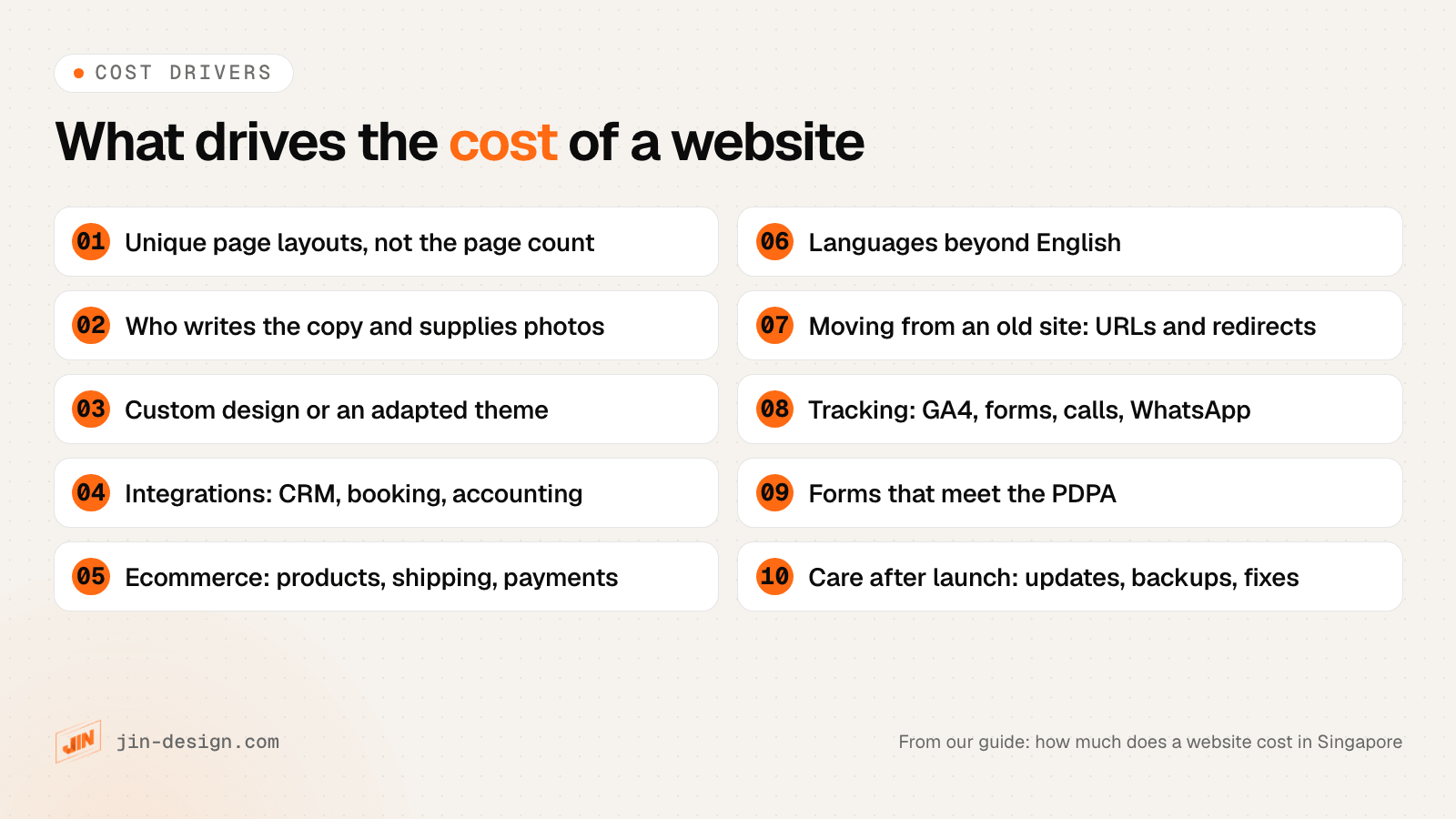
Unique page layouts, not the number of pages
Design and build effort follows the number of different layouts, which agencies often call page templates. A site with 40 service pages that share one layout can take less work than a site with 12 pages that each look different.
When you list your pages, group them by type: home, service, case study, article, contact. The number of types is a better guide to effort than the page count.
Content: who writes it and who supplies photos
Copywriting, editing, photography and image sourcing are real work, and in our projects content is usually the step that takes longest. Say clearly which pages you will write, which you want written, and whether you have photos you own the rights to.
Custom design or an adapted theme
A bespoke design starts from your brand and your customers. An adapted theme starts from a layout someone else designed. Both are legitimate; they cost different amounts and lead to different results, so make sure every quote you compare assumes the same approach.
Integrations with your systems
Online booking, a CRM, accounting software, a membership area or a stock system each add set-up and testing. Name the actual product you use where you can, because “connect to our CRM” can mean a simple form hand-off or a two-way sync.
Ecommerce
For an online store, the main drivers are the number of products and variants, how product data gets into the site, shipping rules, payment methods such as PayNow and cards, and how orders flow into your accounting or stock system.
Languages
Each extra language adds translation, layout checks and search set-up for that language. Plan English, Chinese, Malay or Tamil versions from the start rather than adding them later.
Moving from an old site
A redesign has to protect the addresses Google already knows. That means listing every old URL, keeping the ones that rank and redirecting the rest permanently. When we moved jin-design.com off WordPress, our redirect list ran to more than 250 old addresses, from retired posts to old category pages. It is a real line of work, and a good quote shows it. Our website redesign page explains how we plan that move, and our free redirect checker helps you test the result after launch.
Tracking
Google Analytics 4, Search Console and conversion tracking for forms, calls and WhatsApp clicks tell you whether the site brings in business. If this is not in the quote, nobody will know which pages work.
Forms that meet the PDPA
Forms that collect names, emails or phone numbers fall under the Personal Data Protection Act. The PDPC’s overview of the PDPA explains the obligations. Consent wording, where form data is stored and who can see it all need to be set up and are part of the scope.
Care after launch
After launch, a site needs software updates, security fixes, backups, small content changes and someone to call when something breaks. This is usually a monthly or yearly plan, quoted separately from the build. Our website maintenance page shows what a plan should cover.
| Cost driver | What adds effort | What keeps it lean | Ask the agency |
|---|---|---|---|
| Page layouts | Many one-off designs | Pages that share a few layouts | How many unique layouts does the quote include? |
| Content | Agency writes and sources everything | You supply final copy and photos | Which pages do you write, and how many rounds of edits? |
| Design | Bespoke illustration and animation | An agreed visual style reused across pages | Is the design bespoke or based on a theme? |
| Integrations | Two-way syncs with several systems | One form hand-off to one system | Which systems, and who maintains the connection? |
| Ecommerce | Large catalogue, complex shipping | Small catalogue, simple flat-rate shipping | Who enters products, and how do orders reach our accounts? |
| Languages | Several languages with separate SEO | One language at launch | Who translates, and how does each language rank? |
| Migration | Hundreds of old URLs | A new domain with no history | How will you map and redirect our old pages? |
| Care | Frequent changes, plugin-heavy stack | Few changes, simple stack | What is included each month, and how fast do you respond? |
What are the running costs of a website in Singapore?
The build is paid once. Running costs come back every year, and they often go to several different vendors, which is why they get forgotten when quotes are compared.
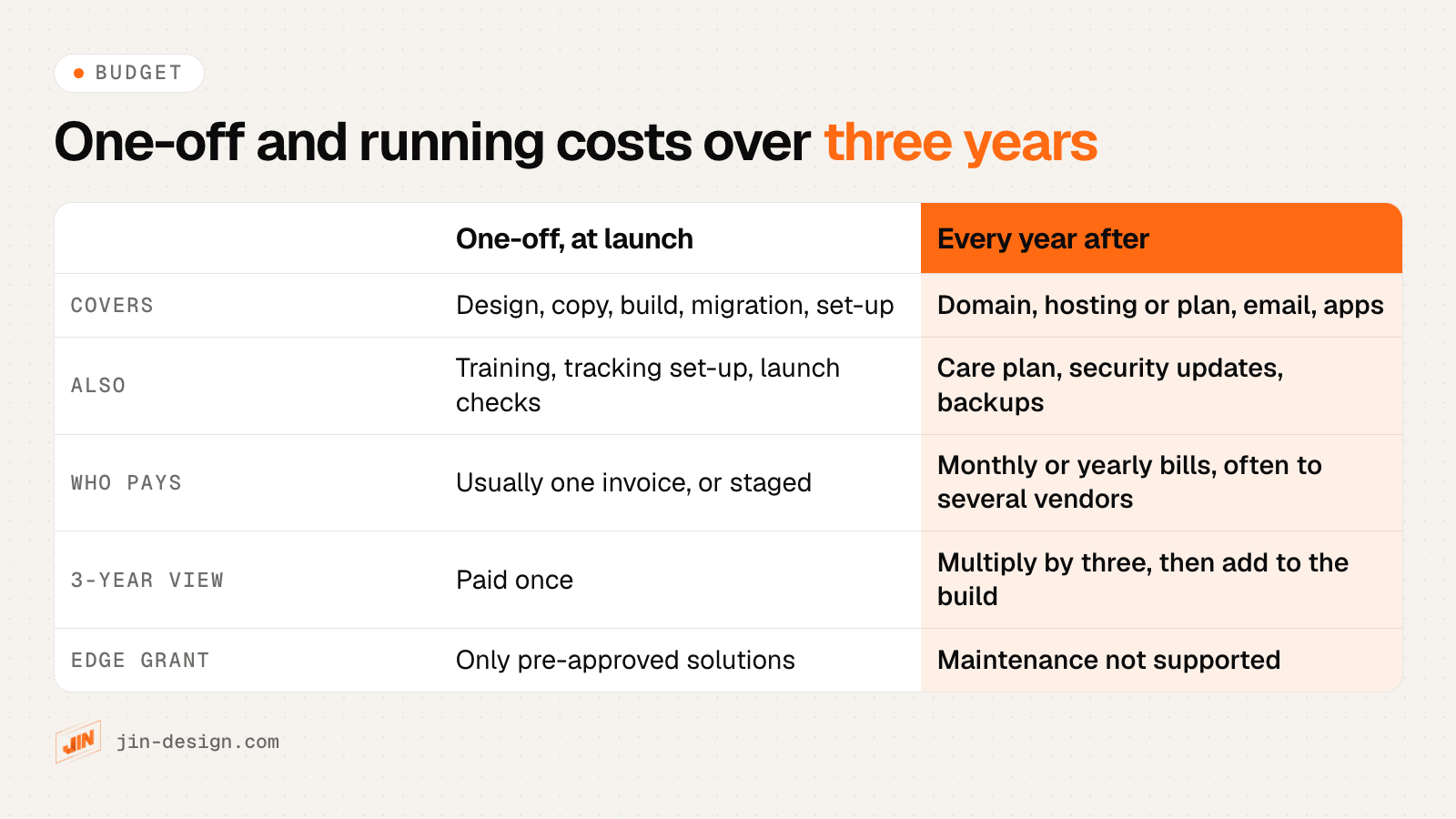
The usual running-cost lines are:
- Domain renewal. A .sg domain is registered and renewed through an accredited registrar, listed by SGNIC. Our guide to domains and hosting explains the difference.
- Hosting or a platform plan. Self-hosted sites such as WordPress pay for hosting. Hosted platforms such as Shopify, Webflow or Wix charge a plan fee that includes hosting.
- Business email, usually priced per user per month.
- Paid plugins, apps or themes, often billed yearly per site.
- A care plan for updates, backups and fixes.
- Payment fees if you sell online, charged per transaction by your payment provider.
To work out a platform plan, take the price from the platform’s own pricing page and note whether it is billed monthly or yearly, because the two rates often differ. Multiply the monthly fee by 36, or the yearly fee by three, for the plan alone. Then add the apps, a paid theme and payment fees on top.
Do this sum for every option on your shortlist. A quote with a lower build price and higher yearly costs can cost more over three years than the alternative.
Can you get a grant for a website in Singapore?
The rules changed on 30 September 2026. Enterprise Singapore stopped accepting new applications for its Productivity Solutions Grant (PSG), the Enterprise Development Grant (EDG) and the Market Readiness Assistance (MRA) grant, and moved to the EDGE Grant.
EDGE grant facts for websites (checked 15 October 2026)
- Enterprise Singapore's PSG, EDG and MRA ceased on 29 September 2026. From 30 September, new applications go under the EDGE Grant. Applications made before then are still processed under the old schemes.
- PSG run by other agencies for their own sectors moves to EDGE in phases from November 2026, according to the GoBusiness PSG FAQ.
- EDGE support is capped at S$100,000 per company per year across all activities, refreshed on 1 April. Automation and digitalisation projects together count towards a S$30,000 yearly cap within that.
- E-Commerce Online Shop (B2C) is a pre-approved solution: the cost of the activity is capped at S$5,000, with up to 50% support for SMEs (S$2,500) and up to 30% for non-SMEs (S$1,500).
- Supported costs are software costs, capped at 12 months. GST and maintenance costs are not supported.
- The vendor and package must come from IMDA SMEs Go Digital, and the package must match the vendor's quotation exactly.
- You must not start work or pay any deposit before you apply, and your company needs at least 30% ownership by Singapore citizens or PRs.
- The list of pre-approved single-function digital solutions has no category for a company or brochure website. Digital Marketing is a separate category, for campaign tools rather than building a site.
Sources: Enterprise Singapore, E-Commerce Online Shop (B2C), single-function digital solutions and EDGE Grant FAQs.
What this means in practice:
- A company website on its own has no pre-approved category, so plan to fund it yourself.
- An online shop can qualify if you use a pre-approved vendor and package. The grant covers up to 50% of up to S$5,000 of the package’s software costs, for 12 months. A larger custom store is quoted outside that package.
- Other digital tools you use alongside the site, such as a CRM, are separate pre-approved categories. The BizSG recommender shows which grants apply to your business.
- Check before paying anything. A deposit paid before you apply makes the application retrospective, and retrospective applications are not supported.
How do you compare website quotes in Singapore?
Comparing totals only works when every quote covers the same scope. Do the work in this order.
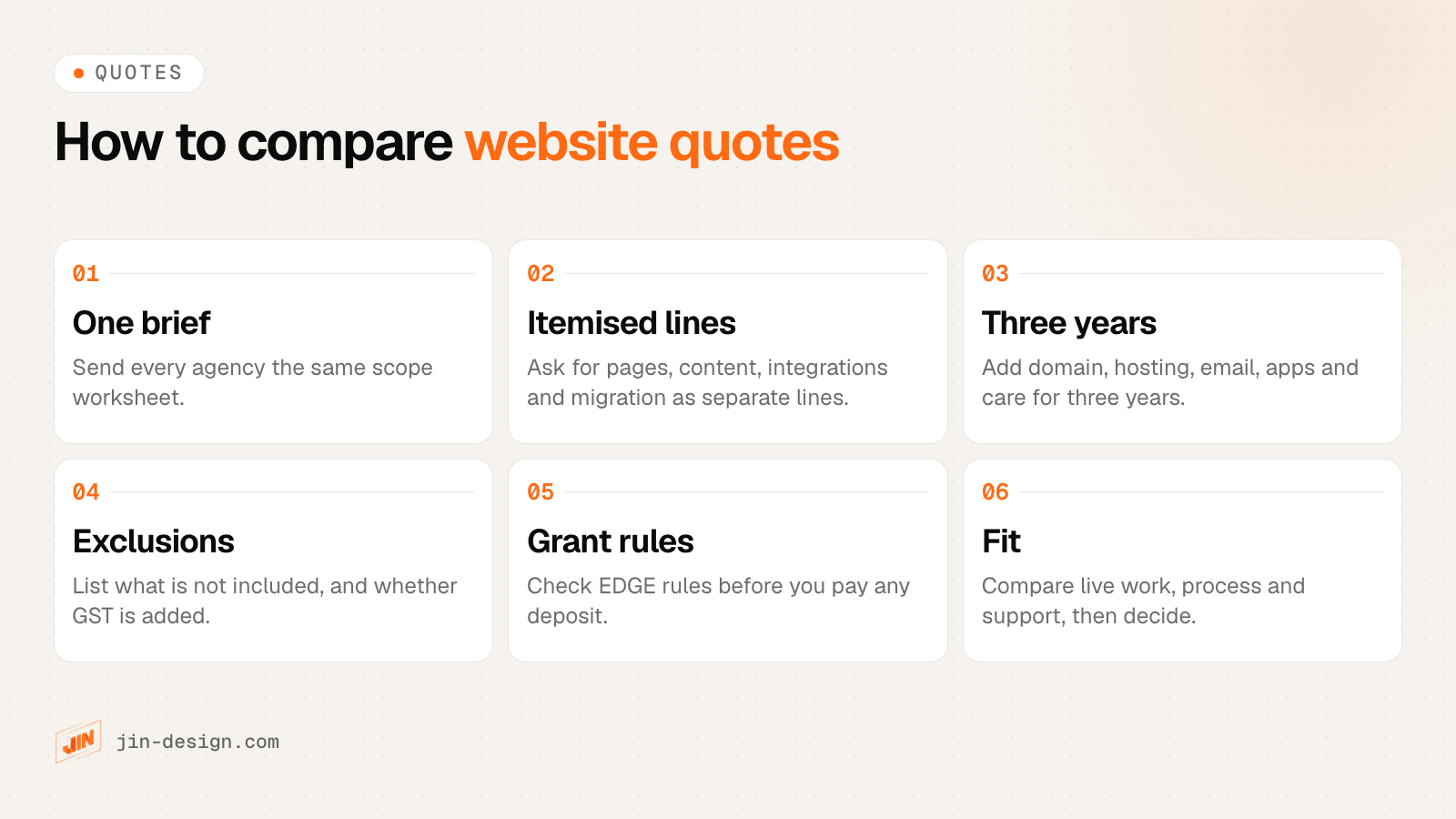
A quote you can compare lists these items separately:
- Discovery, sitemap and wireframes
- The number of unique page layouts designed, and the number of pages built
- Copywriting: which pages, and how many rounds of edits
- Photography, illustration or stock images
- Each integration by name
- Ecommerce set-up: products entered, shipping rules, payment methods
- Each extra language
- Migration: URL mapping, redirects and checks after launch
- Tracking set-up
- Testing, training and launch support
- Running costs for each year, and who bills them
- GST, shown clearly as included or added
Free download
Website scope worksheet (Excel). List your pages, features, integrations and content, mark must-haves and nice-to-haves, type in each quote's running costs for a three-year total, and compare up to three agencies side by side.
Things to check in every website quote
Ask every agency the same questions. A clear answer is a good sign; an unclear one is worth a follow-up email.
- Ask how many unique layouts are included, and what happens if you need one more.
- Confirm who writes the copy, and how many rounds of changes each stage includes.
- Ask for a written list of exclusions, such as photography, translation or content entry.
- Confirm the domain, hosting and platform accounts are in your company’s name, and that you can take the site and its files with you.
- Ask for the plan for your existing pages and redirects if you already have a site.
- Confirm what the care plan includes each month, and how quickly they respond.
- Check whether prices include GST. GST-registered businesses charge 9%, according to IRAS.
- Ask how payment is staged, and what you receive at each milestone.
Our guide on how to choose a web design agency in Singapore has the full list of questions and a scorecard for proposals. If you are still building a shortlist, see our web design companies in Singapore.
How does website scope differ between Singapore businesses?
These are fictional businesses, each needing roughly the same number of pages. The scope, and so the quote, is very different for each one.

A physiotherapy clinic with two branches
The clinic has no website yet, so there is nothing to migrate. It needs a home page, a page per treatment, a page per branch, practitioner profiles and a contact page. Treatment and branch pages each share one layout, so the site needs only five or six layouts.
Online booking connects to the clinic’s existing booking system. Many patients prefer Chinese, so the site launches in English and Chinese. The clinic writes the treatment descriptions and the agency edits them.
What moves the quote most: the second language, which affects every page, and the booking integration.
A coffee roaster moving from marketplaces to its own store
The roaster sells on marketplaces today and wants its own online store with about 40 products, each with grind and size options. It needs product, collection, cart, subscription and story pages: six to eight layouts.
The owner supplies product data and photos. The store needs PayNow and card payments, local delivery rates and orders that flow into the accounting software.
What moves the quote most: catalogue set-up, shipping rules and the order-to-accounting connection. This is also the business most likely to qualify for EDGE support, through a pre-approved online shop package. A platform plan becomes a running cost from day one.
A B2B logistics firm replacing an old WordPress site
The firm’s current site has grown over many years, with hundreds of old pages and posts. The new site needs services, industries, case studies, careers, articles and contact: seven to nine layouts. Enquiries go into the firm’s CRM, and job applications need their own form.
The agency writes most of the copy, because the old content is out of date.
What moves the quote most: migration. Every old URL has to be mapped, the useful ones kept, and the rest redirected, followed by weeks of checking Search Console. Copywriting is the second largest line.
Does AI make a website cheaper to build?
It changes where the hours go. Agencies that use AI well get through research, wireframes, layout options, first drafts of copy and parts of the code faster, so you see real designs sooner and can compare more options.
It does not shrink the parts that depend on your business: deciding what the site must do, writing content that is accurate, testing on real devices, moving old URLs and looking after the site. So scope still sets the cost. When you compare quotes, ask which steps people review, and expect a shorter timeline to show up in the plan.
How we quote a website project in Singapore
We do not publish fixed prices, because no two projects are the same. After a free consultation about what the site has to do, we send a clear, itemised quote, and we agree scope and milestones before we start. You own the domain, the website and the content.
If you want help deciding a platform first, our comparison of WordPress, Webflow and AI-powered websites is a good place to start. To get a quote, fill in the scope worksheet or simply talk to us about your web design or web development project.
Frequently asked questions
How much does a basic website cost in Singapore?
There is no fixed price, because "basic" means different things to different agencies. A small site with a few unique layouts, content you supply and no integrations sits at the low end of any agency's range. Each extra layout, language, integration or migrated page adds work. Send the same written scope to two or three agencies and ask for itemised quotes to see the real figure for your site.
Can I still use the PSG grant for a website?
Enterprise Singapore no longer accepts new PSG applications. It stopped PSG, EDG and MRA on 29 September 2026 and moved to the EDGE Grant from 30 September. Under EDGE, an e-commerce online shop from a pre-approved vendor can get up to 50% support for SMEs, on software costs capped at S$5,000. Applications made before the change are still processed under the old scheme. PSG run by other agencies for their own sectors moves to EDGE in phases from November 2026.
What running costs should I budget for after a website launches?
Plan for the domain renewal, hosting or a platform plan such as Shopify or Webflow, business email, paid plugins, apps or themes, and a care plan for updates, backups and fixes. Add three years of these to the build quote to see the real cost of each option.
Should a website quote in Singapore include GST?
If the agency is GST-registered, it must charge GST, currently 9% according to IRAS. Check whether each quote shows prices before or after GST so you compare like for like. GST is also not a supported cost under the EDGE grant.
Why does redesigning an existing website cost more than building a new one?
An existing site has addresses that Google and other websites already link to. A redesign has to list them, keep the ones that rank, redirect the rest and check Search Console after launch. That migration work is a separate line in a good quote.
Does AI make a website cheaper?
It shortens some stages, such as research, wireframes, layout options and first drafts of copy and code, so you usually see designs sooner. Content, testing, migration and care after launch still take people's time, so scope stays the main driver of cost.